
Stock Market, Money and Investing for Parents

Give Your Kids the Financial Head Start They Deserve!

We Teach YOU how to Teach Your Kids about Money and Investing!

Creating Wealth is not Difficult!

What matters most is understanding the incredible power of compound interest and starting as early as possible.


When your money earns returns, and those returns begin earning their own returns year after year, your wealth grows faster than you can imagine. Even small, consistent investments can snowball into significant wealth over time.


The key is to begin early, stay consistent, and let compounding do the heavy lifting.

THE PROBLEM:

Most Kids Don't Learn About Money

WHY?

There are three main reasons many children miss out on financial education:


  1. Schools Don’t Prioritise It – While some schools teach basic economics, very few include practical lessons on personal finance, budgeting, and investing.
  2. Parents Feel Unqualified – Many adults struggle with their own finances, making them hesitant to teach their children.
  3. Money Is a Taboo Topic – In some families, talking about money feels uncomfortable or even inappropriate.


Unfortunately, avoiding the topic doesn’t protect your child — it leaves them unprepared for the real world.

Why it's essential to teach your kids about Money and Investing!

Without financial education, young people risk falling into debt, missing opportunities to save, and struggling with money as adults.

The most important part of investing is time + compounding = exponential growth.

Learn About Your Two Best Friends

Compounding

Compound interest is the process where the money you earn from an investment (the interest) starts earning interest itself.


Instead of only earning returns on your original amount, you also earn returns on your previous returns — creating a snowball effect that grows bigger over time.

Time

Even small amounts invested consistently can grow into significant wealth when given enough time.


This is why starting early is such a powerful advantage — the longer your money compounds, the larger your investment can become without needing extra effort from you.

Whether your kids are:

 🌟  5 to 7 years old and just starting to explore coins and notes,
🚀 8 to 12 years old and ready to level up your money skills, or
🎯 13 to 18  years old and keen to take charge of your financial future


you’re in the right place.


Here, we turn learning about money into a real adventure with awesome games, cool challenges, and hands-on lessons that make sense.

What You’ll Learn

Money Skills for the Real World

🏦 What is Money?

💰 How to Save & Budget

📈 Investing Made Simple

🛍️ Needs vs. Wants

📊 Starting a Side Hustle

🧾 Taxes & Bank Accounts

🎯 Setting Goals

💳 Smart Spending Habits

Together, we'll dive into everything you'll need to teach your kids about Money and Investing

  • How to earn and save
  • How to make smart choices (so they don’t blow it all on lollies or shoes)
  • How to grow their money for things they dream about — whether it’s a shiny new bike or a future trip around the world.


So come along, join me, and let’s make mastering money for your kids wildly fun!

Here are some great resources!

By Ozzy the Koala August 12, 2025
Teach kids aged 5–7 the basics of money, saving, and investing. Includes Three Jars labels, savings tracker, and skills checklist for parents.
Family of four smiling and looking at an open book, with soft lighting.
By Ozzy the Koala August 11, 2025
Teach kids aged 8–12 how to budget, save, earn, and invest with our step-by-step money education plan for parents. Includes real-life examples to raise confident, money-smart kids.
Family of four in a kitchen, smiling and holding books, with a bright and cheerful atmosphere.
By Ozzy the Koala August 10, 2025
Help your teenager master budgeting, saving, earning, and investing with our step-by-step money education plan for ages 13–17.
Two cartoon people with glasses reading books in a colorful  setting.
By Ozzy The Koala August 7, 2025
Find out the best time to start teaching kids about money and investing. Age-by-age guide, practical tips, and strategies for raising money-smart children.
A mother
By Ozzy the Koala August 3, 2025
Discover when is the best time to start teaching kids about money and investing. Learn practical tips for parents to raise money-smart children. Nextgen Money
 teaching kids about money and investing
By Ozzy July 30, 2025
Discover why teaching kids about money and investing sets them up for lifelong financial success. Learn practical tips for parents to raise money-smart children.
Show More

START HERE

Learn By Age

Money Lessons That Grow With You

Whether you're just starting out with coins or dreaming of building your first investment portfolio, we've got age-appropriate tools to help you grow.

Ages 5 to 7: Money Explorers

Learn about coins, saving jars, and fun spending choices.

Ages 8 to 12: Smart Spenders

Budget your pocket money, save for goals, and explore ways to earn.

Ages 13 to 17: Future Investors

Build your money mindset with real-world investing tips and career ideas.

Play & Learn

Games, Quizzes and Challenges

Learn by doing!


Explore our free interactive games that make saving, spending, and investing fun and easy to understand.

🎯 Budget Buster Game – Try to budget your weekly allowance!


📈 Stock Market Simulator – Make fictional trades and grow your portfolio.


🧠 Money Mind Quiz – Find out what kind of saver or spender you are.

Parents & Teachers

Plans, Worksheets and Guides

We make it easy for parents and educators to teach kids about money.


Get lesson plans, printable worksheets, and age-based guides—all in one place.
For Teachers and Parents
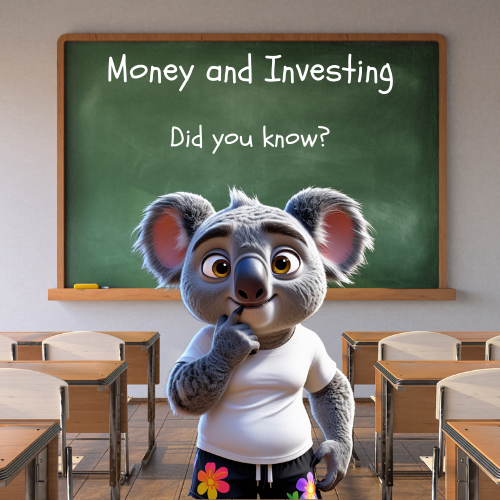
A koala bear is standing in front of a blackboard that says money and investing did you know

Did you know? If you save $5 a week from age 10, you could have over $4,000 by the time you're 18!

Did you know? The youngest person to invest in the stock market was only 9 years old!

Did you know? Saving helps you prepare for the future. Whether you’re a kid saving for a toy or a teen saving for a car, putting aside even small amounts adds up over time. It also teaches patience and goal-setting—two superpowers for life!

Did you know? A budget is like a plan for your money. It helps you know how much is coming in and how much is going out. Even with small amounts, budgeting teaches you how to make smart choices, avoid debt, and reach your goals faster.

Did you know? When you invest, your money can earn more money over time—like planting a seed and watching it grow. This could be through a savings account, shares, or a business. The earlier you start learning about investing, the better!

Why Teaching Money and Investing to Kids and Teenagers Matters Now More Than Ever!

In an age of tap-and-go, online subscriptions, and digital wallets, understanding money is no longer optional—it’s essential.


Yet for many young Australians, financial literacy is still a mystery.


By introducing key money and investing concepts early, we empower children not just to count coins or save for a toy, but to build lifelong habits that set them up for success. Money doesn’t have to be a taboo topic—it can be playful, practical, and even empowering. And the earlier we start the conversation, the better prepared our next generation will be to face a future that’s fast, fluid, and financially complex.


5 to 7

From the foundational years of 5 to 7, kids are already noticing how money works—watching parents pay for groceries, earn wages, or tap a card at a café.


This is the perfect time to introduce fun and simple ideas like “needs vs. wants,” coin recognition, and basic saving goals. Visual tools like jars, charts, and role-play help young minds connect behaviour with outcomes.


Teaching them to pause, plan, and save—even in small ways—plants the seed for smarter spending later in life.

8 to 12

As kids move into the 8 to 12 range, they’re increasingly curious about independence, value, and earning.


This is the golden window for hands-on learning: pocket money, budgeting games, and starting tiny businesses like lemonade stands or dog-walking gigs.


These pre-teens are not just ready—they’re eager to learn how money flows. They start to grasp the bigger picture: the value of effort, the role of savings, and how money can be used not just to spend, but to grow.

13 to 17

For teens aged 13 to 17, the stakes get real—and so does their potential.


Whether they’re considering their first job, planning a gap year, or opening a bank account, they’re navigating decisions that have real financial consequences. This is the time to introduce compound interest, investing basics, superannuation, and even tax. It’s not about turning them into stockbrokers. It’s about giving them the confidence and tools to take control of their future.


With the right guidance, they can become not just consumers, but conscious, confident investors in their own lives.


Teaching money and investing isn't about numbers—it’s about nurturing independence, responsibility, and resilience. It’s about giving every Australian child, no matter their background, the chance to shape a better financial future.


For parents and teachers, the role is simple but powerful: start the conversations, offer the tools, and support the journey.


Whether your child is 5 or 17, the time to begin is now.


Because when we teach kids how to manage money, we teach them how to manage life.

Join the Money Explorers Crew

Get cool tips, new games, and fun challenges delivered to your inbox!

Join Here